Catching Up With Golf Trailblazer Casey Martin
[Editor’s note: This article is from The Spun’s “Then and Now” magazine, featuring interviews with more than 50 sports stars of yesteryear. Order your copy online today, or pick one up at retail racks and newsstands nationwide.]
It was quite the wake-up call. On a Tuesday morning in the spring of 2001, Casey Martin was asleep when his phone rang at his West Coast home. He groggily looked at the number on the screen, recognized the Florida area code, and picked up. As a professional golfer, the voice of then–PGA Tour Commissioner Tim Finchem was unmistakable.
“Congratulations,” Finchem offered.
Martin knew exactly what that meant. The commissioner, whose tour had been the golfer’s foe in court for nearly four years, was like a general laying down his sword. That morning, Finchem was informed that the U.S. Supreme Court had voted 7–2 in favor of Martin in his bid to use an electric cart in competition because of a birth defect that caused him constant pain in his right leg. The legal fight—which pitted Martin’s desire to compete on tour against the opinions of golf greats such as Arnold Palmer and Jack Nicklaus—had gone to the highest court in the land. And though there was no trophy to hoist, it was a triumph of the way Martin had lived his entire life: with grit, resilience, and a sense of redemption.
Nearly 24 years to the day after that decision, Martin recalled feeling relief more than anything, “because there was just so much unknown for my future.”
“Certainly, it was rewarding to know that the door was open for somebody in some other field, because if it applies to sport, it’s gonna apply to everything,” he said. “It felt good to know that the next person down the line will have a little easier go, for sure.”
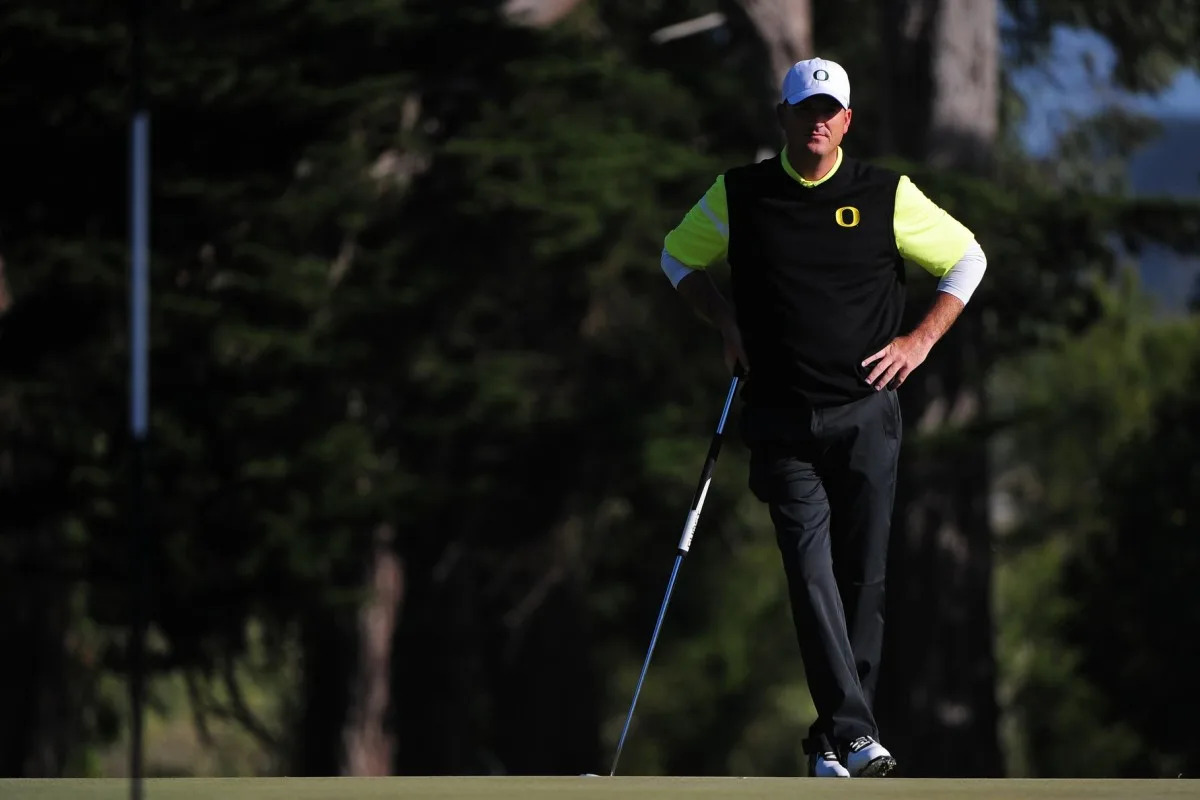
Casey Martin waits on the 14th hole during the second round of the 112th U.S. Open at The Olympic Club in San Francisco on June 15, 2012.Kyle Terada-Imagn Images
Today, Martin, 53, is one of the most respected and successful coaches in college golf. A decade into his tenure, the Oregon Ducks won the 2016 NCAA Division I championship at home in Eugene, Ore. It marked only the third time that a person had captured men’s national team titles as both a player and a coach. (Martin’s Stanford squad won the 1994 NCAA championship a year before Tiger Woods joined the Cardinal.)
That Martin reached the top of the professional game after college is nothing short of remarkable. He was born with Klippel–Trénaunay syndrome, a rare congenital condition that affects blood vessels, bone, and soft tissue. In Martin’s case, his right leg was most affected, but that didn’t stop him from passionately pursuing golf from a young age.
Martin qualified for the PGA Tour’s developmental circuit—then called the Nike Tour, now known as the Korn Ferry Tour—and in 1999, he finished 14th on the money list to reach golf’s big leagues for the first time. By then, he had already started his legal battle, citing the Americans with Disabilities Act to be able to use a cart in competition because walking six to eight miles per round was extremely taxing and painful.
The PGA Tour fought back, saying it feared a ruling in Martin’s favor could fundamentally change a competition that required all of its players to walk the course. For some, it seemed like the soul of the game was being attacked, and numerous legendary golfers testified against Martin, including Palmer, who cited the “physicality” of the game. Palmer said: “A golf cart is a pretty relaxing way to get around the golf course and you would probably keep a lot more of the stamina.”
Martin knew the comments weren’t personal, but they hurt deeply nonetheless. Looking back, he said he’s grateful that social media didn’t yet exist.
“It would have been a really difficult thing to do today, with all the people accessing you and telling you their opinions, whether they love you or hate you,” said Martin. “Even back then, I’d get hate mail.”
Casey Martin is seen at the 1998 U.S. Open in San Francisco.Stan Badz/PGA TOUR Archive
Unfortunately, by the time of the Supreme Court decision, Martin’s career was on the downturn, even while being able to ride. His only season on the PGA Tour would be 2000, and he didn’t retain his playing privileges. Though he kept his status on the Nike Tour through 2003, he rarely contended and never won.
“I was a good player, but I had a ways to go to get to the level of where I wanted to be, and I had to deal with a lot of distractions, a lot of expectations,” Martin says. “That was difficult, for sure. I did learn a lot about myself through those ups and downs.”
Nurturing his Oregon players with his experience and lessons from his past has been Martin’s primary focus over the last two decades, but he still worked diligently on his game, often razzing his players when he beat them. A few years ago, Martin experienced a swing breakthrough that had him believing he would give the senior PGA Tour Champions a legitimate shot when he turned 50. He was playing some of the best golf of his life.
But that dream ended on a night in October 2019, when Martin misstepped while taking out the garbage, fracturing the tibia in his right leg. For most, the injury would take a couple of months to heal; for Martin, it was life-changing. Doctors spent the next two years working to heal the leg, but nothing helped, leaving Martin suffering extreme pain while doing the most mundane activities.
Finally, with no prospects of the leg recovering, Martin made the agonizing decision he figured was inevitable: amputation.
“I always felt this would be my destiny,” Martin told Golf Digest at the time.
University of Oregon head coach Casey Martin of Oregon celebrates after the Ducks won the NCAA Division I Men's Golf Championship in Eugene, Oregon, on June 1, 2016.Steve Dykes/Getty Images
In October 2021, the above-the-knee amputation of Martin’s right leg was performed. The hope was that he’d finally be released from the pain he’d known since childhood. But it hasn’t worked out that way. Martin suffered phantom pain, and adjusting to prosthetics has been difficult.
Nearly four years after the surgery, Martin uses a cane to walk and has “a new batch of pains.”
“I don’t regret doing it, but I’m not going to lie—it’s a lot,” Martin said. “The pain is different and it’s lessened from the break, but it’s also increased in other ways.”
Martin said he’s no longer able to play golf.
There have been some “dark days,” Martin admitted, but he remains motivated to mentor and mold his players at Oregon. They would be best served to take heed from one of golf’s true survivors.
Related: 'Then and Now' Magazine: Catch Up With 50 Sports Stars of Yesteryear
Related: Catching Up With Golf Great Annika Sorenstam
This story was originally published by The Spun on Jan 14, 2026, where it first appeared in the Golf section. Add The Spun as a Preferred Source by clicking here.