Midseason Report Card: Grading Michigan State Basketball
Yes, the Spartans have played 17 games and only have 14 remaining—so not exactly halfway—but we can round down a tad to get the idea of the article.
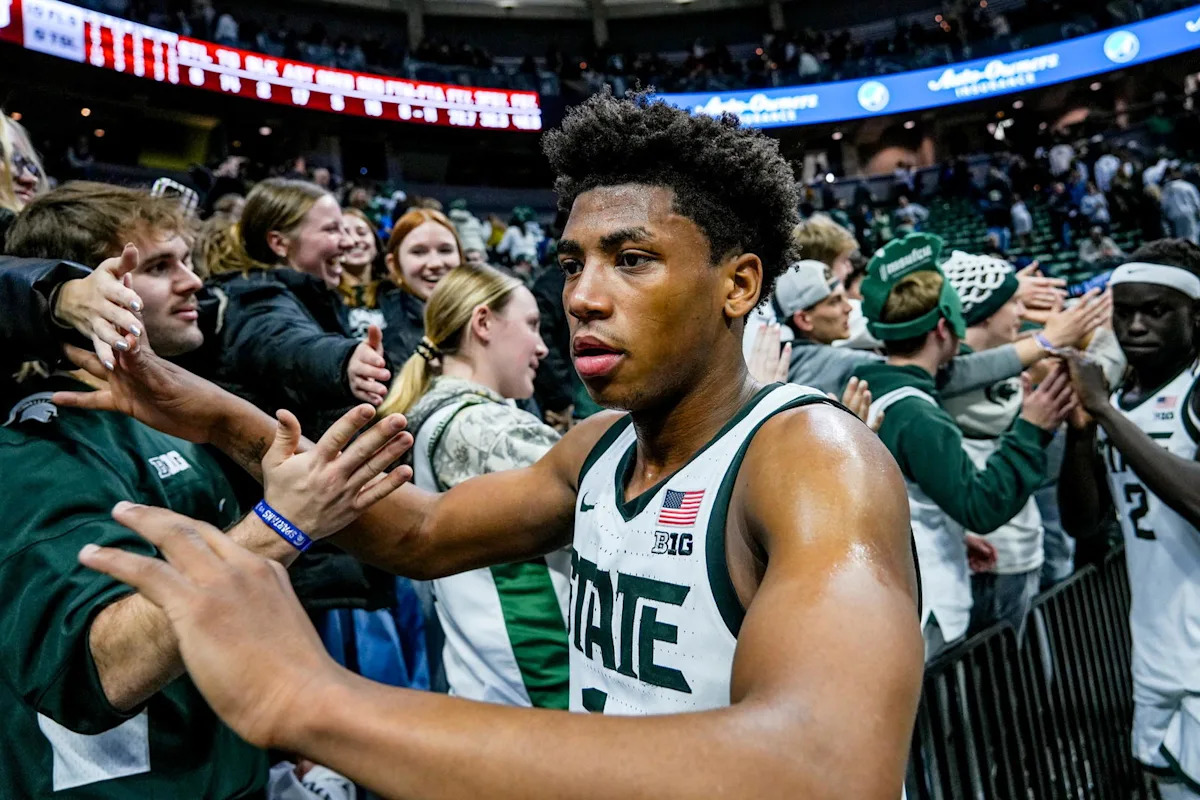
Just over halfway through the season, the Spartans sit at 15–2 overall and 5–1 in conference play. They are currently tied for third in the Big Ten with Michigan and Illinois, trailing Purdue and Nebraska, who remain undefeated in Big Ten play (with Nebraska undefeated overall at 17–0).
The Big Ten represents five of the top 13 teams in the country and produces epic basketball games on a nightly basis. The Spartans, with just two losses on the season—to two teams with a combined one loss (Nebraska and Duke)—rank fourth among the top five Big Ten teams in the AP Poll, just one spot ahead of Illinois (No. 13).
Michigan State’s 15–2 start marks the fourth time in the past nine seasons and the second straight year (‘18–19, ‘19–20, ‘24–25, ‘25–26). However, with the Spartans back to another strong start, there’s no reason to look backward. The logo may be the same, but the team is always different.
So now, let’s take a look at how we would grade this team.
Rebounding — A“Rebounding University” has been the nickname all year, and it’s not going away—at least not if the Spartans want to turn this season into something special. Michigan State’s big men—Jaxon Kohler, Carson Cooper, and Coen Carr—are an integral part of this team’s success. Not from an offensive standpoint, but through physicality. They are the heartbeat of this team.
Some might think that role belongs to point guard Jeremy Fears, but he’s more the quarterback, while the big men are the trenches.
The Spartans rank tied for 15th nationally, averaging 12.2 offensive rebounds per game, and sit alone at eighth overall in rebounds per game at a whopping 39.5.
Those numbers tell the story. Nearly every missed opponent shot is vacuumed up by Michigan State, and when the Spartans miss, the big men are often there to clean up the trash and provide second-chance points.
This is the biggest key to MSU’s success. As long as the bigs continue to play gritty, mean, tough basketball down low, the Spartans have a real shot at cutting down the nets.
Shooting — BThis category comes with an array of stats and context. Take Jaxon Kohler, for example—his shooting is not just an A, it’s above and beyond. Kohler’s three-point shooting has been a catalyst for this offense, often finishing as the team’s leading scorer.
But outside of him, shooting has been—as the kids say—sus.
Jeremy Fears went on a tear in the last game, finishing with a career-high scoring output, but prior to that hadn’t made a single three-pointer in Big Ten play. The early-season two-guard battle between Divine Ugochukwu, Kur Teng, and Trey Fort was abysmal. Teng lost his starting role to Ugochukwu before the Penn State game, where Ugochukwu scored 23 points—but outside of that performance, he has scored more than six points just twice all season.
Teng now comes off the bench most games and provides a noticeable spark. He’s finding rhythm and confidence in his shot.
As a team, the Spartans rank tied for 116th nationally in field-goal percentage (46.7%) and tied for 101st in three-point shooting (35.5%). These numbers aren’t disastrous, and the team is growing daily. Freshmen Cam Ward and Jordan Scott have struggled at times, but with experience they could become sneaky shooters down the stretch.
Still, if Michigan State wants to compete with the big dogs, they must knock down perimeter shots and not rely solely on post scoring.
Turnovers — DThis category has flat-out damned Michigan State in some games—most notably the two-point loss to Nebraska, where the Spartans turned the ball over an unbelievable 21 times, including five straight empty possessions.
Michigan State ranks 240th nationally in turnovers, averaging 12.1 per game. It’s an ugly stat and one that could lead to an early tournament exit if not addressed. With nearly half the season remaining, the Spartans must learn how to play fast and take care of the basketball if they want to keep pace with teams that average 90 points per game.
Defense — AThis team embodies what a true black-and-blue program looks like. Stifling defense paired with elite rebounding is how the Spartans will win games and slow down high-octane offenses.
The big men anchor this unit, but Jeremy Fears’ quick hands are just as impactful. Even more impressive is the bench defense. When Jordan Scott, Cam Ward, and Jesse McCullough check in, they don’t just bring defense—they bring energy.
That kind of youth-driven chaos throws a wrench into opponents’ plans. Around Izzo, defense earns minutes, and this group plays Upper Peninsula–type defense—trapping, swarming, and burying teams like they just got hit with two feet of snow in minutes.
Overall — BThis team could be great. Some may ask how a team with just two losses—both to near-perfect opponents—doesn’t earn an A.
It’s simple: A’s are reserved for elite teams, and the Spartans aren’t there yet.
They can get there, but it takes time. And if you’ve watched Michigan State basketball long enough, you know that time usually pays off in March.
Izzo will keep pushing improvement and consistency. This group has the potential to earn a No. 1 seed, but they must close out their final 14 Big Ten games with statement wins.
That stretch begins this Saturday with a tough West Coast trip to face Washington and Oregon. Those trips are difficult even for elite teams. This grading could rise quickly—and it starts with statement performances out west.