
How David McLay Kidd doubled down on fun with new Scarecrow course at Gamble Sands—giving him another Best New winner
The first course at Gamble Sands opened in 2014 and marked David Kidd’s return to “happy” architecture after a detour into the dark corners of extreme design at places like Tetherow and St. Andrews’ Castle Course. With its broad fairways, half-par holes and feeding contours, the Sands was swashbuckling fun tailored to the joys of resort golfers rather than the vanities of elite players, and each course Kidd has built since possesses elements of this formula.
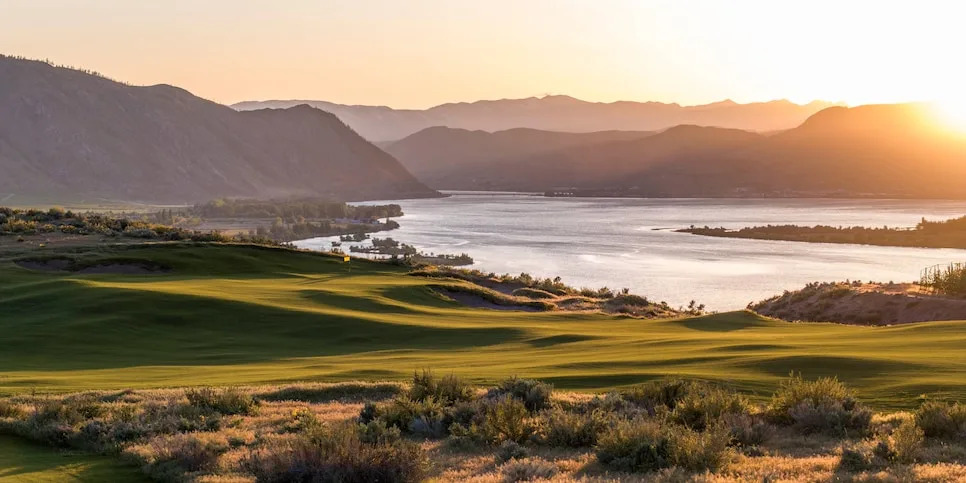
For Scarecrow, Gamble Sands’ second course, the question was how to incorporate the trademarks of the first—width, versatility, the ground game, wall-to-wall fescue turf—without replicating it. Both courses showcase panoramas of central Washington’s wide Columbia River valley, but whereas Sands plays primarily at the same grade across a broad benchland, the new course climbs and plunges, with holes like three, six, 10 and 14 climbing up and downhill as much as 70 feet. The heart of the routing, three through 14, plays across parts of what were formerly 100-acre agricultural patches covered by circular water pivots where the natural nuance and interest had been scraped away by dozers. Kidd and his shapers imagined the site as it might have been and gouged ravines and arroyos, making low spots lower and the highs higher.
/content/dam/images/golfdigest/fullset/2023/1/Scarecrow Oar 2.jpg
Brian Oar
A hallmark of the Sands design is long, diagonal tee shots over valleys and open washes of sand. Kidd and his lead associate, Nick Schaan, decided not to do that at Scarecrow, so the bunkers are smaller and more gnarly. The greens are also smaller but have much more internal movement than the Sands course, where even shots that miss the greens often result in recoveries with minimal break. “That’s not the case at Scarecrow,” Kidd says. “You can land the ball on the green, catch a slope and it will bounce into a hollow. You’ll have a lie you can putt from, but it’s going to have to go up a slope, onto the putting surface and then deal with a contour. The recoveries are a little more complex.”
/content/dam/images/golfdigest/fullset/2023/1/Scarecrow Oar Overview.jpg
Brian Oar
Scarecrow gives Gamble Sands a robust counterpoint to its original course. Most golfers can swing aggressively and stoke their egos at Sands, then see if they can hold it together on a sibling that demands more from their game. “We expected players to say Scarecrow is a little tougher, and that’s generally been the reaction so far,” Kidd says. “We were willing to push the design to the point that it might offend you, and there are holes that people might walk off with doubles or triples and say, ‘That wasn’t fair!’ ” He’s perfectly OK with that—golf isn’t meant to be fair. It is meant to be fun, and early signs indicate Gamble Sands has just doubled it.
/content/dam/images/golfdigest/fullset/2023/1/Scarecrow Oar 3.jpg
Brian Oar
Kidd won his first Best New Course award for the original Bandon Dunes course in 1999. He also won Best Transformation in 2022 for Entrada at Snow Canyon in Utah and earned a runner-up in the 2018 Best New Public contest for Mammoth Dunes at Sand Valley.
Here's drone footage from Jeff Marsh of the Scarecrow course at Gamble Sands:
More from Golf Digest
Golf Digest Logo The Fall Line is golf's next great exclusive club—and our experts got a first look
SECOND PLACE THE KEEP AT MCLEMORE
/content/dam/images/golfdigest/fullset/2023/1/The Keep BaileyRoubus_y.jpg
Bailey Roubus
Rising Fawn, Ga. 7,700 yards, par 72 Architects: Bill Bergin, Rees Jones
/content/dam/images/golfdigest/fullset/2023/1/The Keep 10_JeffMarsh_.JPG
Jeff Marsh
The Keep’s scenic vantage point, peering over a flank of Lookout Mountain in northwest Georgia from over 300 feet above the valley below, is almost unmatched for an inland course. Five holes flow along the cliff edge with the rest routed through the open interior providing views that stretch 10 to 20 miles into the distance. Friendly for resort golfers, the wide fairways tumble toward ample greens that alternate between gentle, almost flat surfaces like the first and 12th and more accentuated surfaces that demand short-game acumen. The par 5s are the strength of the design, but the best single hole might be the par-4 ninth playing into an elevated skyline green set against the vast horizon.
THIRD PLACE THE ROOST AT CABOT CITRUS FARMS
/content/dam/images/golfdigest/fullset/course-photos-for-places-to-play/Carolina Pines Golf _ Cabot Citrus Farms Roost.jpg
Courtesy of Cabot/Carolina Pines Golf
The second course to open at the old World Woods property an hour north of Tampa is a sublime counterpoint to Cabot’s more volatile first course, Karoo, the ego to that design’s id. All the golf at Cabot Citrus Farms is big and expressionistic, but The Roost also possesses an elegant coherence, partly derived from its tranquil setting amid moss-draped oaks, a terrific achievement given that four designers had input. Whitman, architect of Cabot Links in Nova Scotia, shaped the greens, and his artistic sweeps and dips and fades at holes like the par-5 third and par-4 15th carry the day, pushing right against the edge of extremity without stepping over.
/content/dam/images/golfdigest/fullset/2023/1/The Roost 3.jpg
Komo Golf
More from Golf Digest
Golf Digest Logo Best New Courses of 2025: Thousands of ratings from our experts determined the latest winners
HONORABLE MENTION 1 / 4
/content/dam/images/golfdigest/fullset/2023/1/AILERON GOLF_SHOOT_JAN_2024_-166.jpg
2 / 4
/content/dam/images/golfdigest/fullset/2023/1/AILERON GOLF_SHOOT_JAN_2024_-170.jpg
3 / 4
/content/dam/images/golfdigest/fullset/2023/1/Aileron_033_web.jpg
4 / 4
/content/dam/images/golfdigest/fullset/2023/1/Aileron_045_HiRes-edit.jpg
Previous Next Pause PlaySave for later Private Aileron G.C. at Sunseeker Resort Lake Suzy, FL 3.8 5Panelists Aileron is the former Kingsway Country Club, now the key attraction at the new Sunseeker Resort near Port Charlotte, north of Ft. Myers. The course was originally built in 1972 by Ron Garl the prince of golf design in southwest Florida. In 2023, Kipp Schulties, another architect who has been equally prolific in the southern part of the state, remodeled the newly rebranded course. The design plays into the resort demographic and wants to emphasize fun, strong conditioning and recoverability, though care must be taken to avoid water that comes into play on 16 holes. View Course 1 / 2
/content/dam/images/golfdigest/fullset/2023/1/Bella Ridge - Back 9.jpg
2 / 2
/content/dam/images/golfdigest/fullset/2023/1/BellaRidge-Hole17.jpg
Previous Next Pause PlaySave for later Public Bella Ridge Golf Course Johnstown, CO 4.2 10Panelists Architect Art Schaupeter, a University of Colorado graduate, has carved out a niche in the Front Range golf scene north of Denver. After previously designing Highland Meadows and TPC Colorado, he opened Bella Ridge in 2025, a public course between Johnstown and Berthoud and within miles of his other two courses. The holes ride across the site’s open plains with panoramas of the Rocky Mountains. Long, ribbon tees flow directly into the fairways shaped with ripples and hollows to get the tee shots moving in different directions and to set up curious angles into the generally small greens. Ravines and riverbeds intersect the site and are used as frontal and lateral obstacles, and three par 4s ranging from 276 to 310 yards offer plenty of gambling opportunity. View Course 1 / 6
corica-park-north-57995
Derek Duncan
/content/dam/images/golfdigest/fullset/course-photos-for-places-to-play/corica-park-north-second-57995.jpg
Derek Duncan
/content/dam/images/golfdigest/fullset/course-photos-for-places-to-play/corica-park-north-second-57995.jpg
Derek Duncan
/content/dam/images/golfdigest/fullset/2023/1/Corica North Course Hole 12.jpg
AJ PANGELINAN
/content/dam/images/golfdigest/fullset/2023/1/Corica North Course Hole 17.jpg
AJ PANGELINAN
/content/dam/images/golfdigest/fullset/2023/1/Corica North Course Hole 13.jpg
AJ PANGELINAN
Previous Next Pause PlaySave for later Public Corica Park: North Alameda, CA The North Course at Corica Park, one of the best affordable 36-hole public facilities in the U.S., has had an interesting decade. It was built in the late 1920s by the great California architect Billy Bell. In the 1950s, the southern part of the property was converted into a second course that was remodeled in the late 1960s by Desmond Muirhead. The two courses experienced the typical ups and downs of city golf (they were known as the Alameda Municipal courses) until 2018 when Rees Jones remodeled the South Course and elevated it into a stylish venue with tight, fast fairways worthy of out-of-town attention. The success of the rejuvenated South Course convinced the course operators to turn their attention to the shorter, run-down North Course. They hired Australian designer and construction specialist Marc Logan, who had assisted Jones with the South Course, to initiate the renovation with consultation from Golf Digest architecture emeritus Ron Whitten. Logan secured a stream of affordable bulk sand to be hauled in from a project in San Francisco that he used to cap the entire site, enabling him and Whitten to shape faux, wind-blown dunes and exaggerated fairway and green contour onto the flat site, along with other cost-saving innovations like using old field turf from football stadiums as bunker liners. They completed and temporarily opened the first nine of the North Course (the second nine was still unshaped) until a messy legal dispute within the management company and with the city of Alameda paused construction for over two years. When the lawsuits were finally untangled, the city looked to start fresh and hired Robert Trent Jones II and his firm to complete the construction of the second nine. Jones and company honored the themes established on the first nine, creating wavy fairways and greens , allowing the ground contour to be the defining characteristic. The North Course, completed in 2025, is a fascinating design at less than 6,400 yards and with only 20 bunkers, showing that ingenuity and good ideas can overcome politics and economics. View Course 1 / 3
/content/dam/images/golfdigest/fullset/2023/1/Old Fort TN 2.jpg
Alex Leeth Photography
/content/dam/images/golfdigest/fullset/2023/1/Old Fort TN 3.jpg
Alex Leeth Photography
/content/dam/images/golfdigest/fullset/2023/1/Old Fort TN 1.jpg
Alex Leeth Photography
Previous Next Pause PlaySave for later Public Old Fort G.C. Murfreesboro, TN 3.7 10Panelists This municipal course southeast of Nashville received a beautiful, economical renovation in 2024 from architect Nathan Crace. The efficiently routed course, first opened in 1985, plays primarily within a lovely horseshoe bend of the West Fork Stones River with holes bordered by mature hardwoods and natural native areas. Par fours at four and seven set up with tee shots over the river, and the 12th and 16th holes share a St. Andrews-like double green. Crace’s work included the reconstruction and relocation of bunkers along with the installation of Better Billy Bunker liners. He expanded and recontoured the green surfaces to capture more hole locations and regressed them with PRIZM zoysia. He also added new back tees to take the yardage over 7,200 yards and revamped the practice area creating more teeing space and a private lessons area. Best of all, the work was completed for less than $2 million, a fraction of what most private clubs spend for similar work. View Course 1 / 7
/content/dam/images/golfdigest/fullset/2023/1/Watersound The Third 2.jpg
Watersound Club
/content/dam/images/golfdigest/fullset/2023/1/Watersound The Third drone.jpg
Watersound Club
/content/dam/images/golfdigest/fullset/2023/1/Watersound The Third 3.jpg
Watersound Club
/content/dam/images/golfdigest/fullset/2023/1/Watersound The Third ground.jpg
KURT LISCHKA
/content/dam/images/golfdigest/fullset/2023/1/Watersound The Third 5.jpeg
Derek Duncan
/content/dam/images/golfdigest/fullset/2023/1/The Third 7.jpeg
Derek Duncan
/content/dam/images/golfdigest/fullset/2023/1/The Third 12g.jpeg
Derek Duncan
Previous Next Pause Play Save for later Private Watersound Club: The Third Panama City Beach, FL 4.2 6 Panelists It takes vision to build a good golf course on a flat property, especially one with little variation in trees or landscape. It takes courage to build one without resorting to digging out lakes or creating big manmade features to dress up the site. Mark and Davis Love III, along with lead architect Scot Sherman, showed both at The Third, the third course at the large Watersound development in Northwest Florida. Located just north of the Shark’s Tooth course in an enclave west of Panama City Beach, The Third plays in isolation through corridors of a flat pine forest that could easily turn a round into a monotonous one if not handled creatively.The designers played their hand smartly by allowing the golf rather than eye candy to do the talking through broad, fast-running fairways and intriguing green complexes, some perched above roll offs and others playing at fairway grade. Everything is low-profile and simplified without unnecessary adornment, just tees, attractive bunkers and greens. The tight turf makes the game surprisingly links-like—you need to pick your line and hit it, and most putting surfaces set up for bouncing shots. That’s not to say The Third without its own kind of flair. Features like the Biarritz-inspired putting surface at the par-4 seventh or the wavy, 50-yard-deep green at the par-3 14th where hole locations can vary four clubs keep attention locked in. View Course
RELATED: Trout National is one of the most hyped new courses in recent memory. And we got a first look
Explore Golf Digest's new Course Reviews section where you can submit a star rating and evaluation on all the courses you’ve played. We've collected tens of thousands of reviews from our course-ranking panelists to deliver a premium experience, which includes course rankings, experts' opinions, bonus course photography, videos and much more. Check it out here!









.webp)